

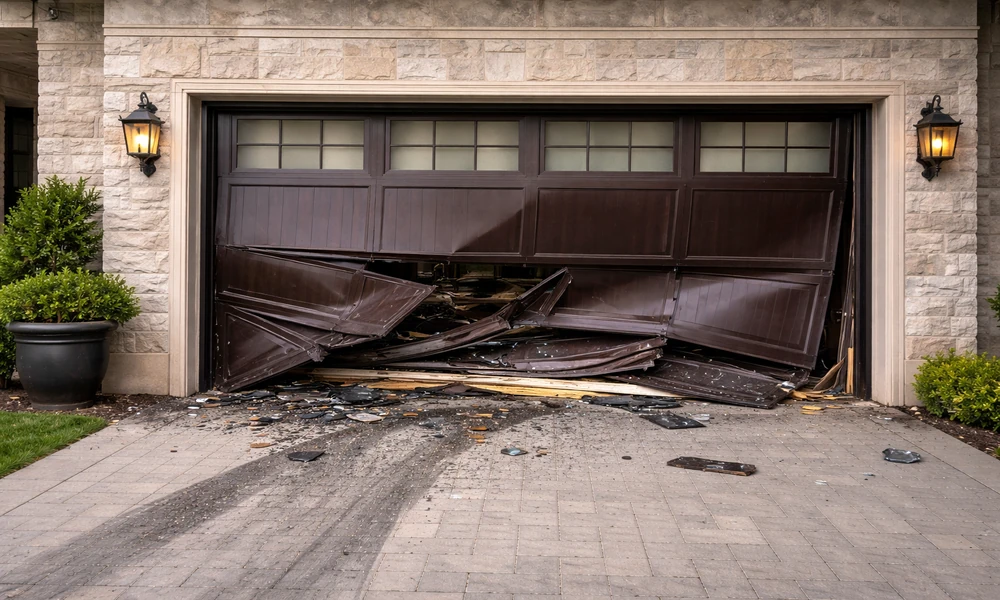
Two things happen when a garage door fails after dark. Your car is stuck on the wrong side of a wall, and every yank on the manual release makes you more convinced you’re about to break something expensive. Four out of five after-hours calls I’ve read about trace back to one of five parts, and the part that broke tells you exactly what to do next.
My stance, up front: the only after-hours failure worth touching yourself is a dead opener. Everything else, particularly anything involving a snapped spring, stays closed until a pro gets there. Call emergency garage door repair in Atlanta for a trapped car or hanging door and let someone with the right tools take the risk.
Here’s the useful part: the failure itself is a diagnostic. Where the door stopped, what noise it made, what the light on the opener did. Read those three clues correctly and you’ll know whether you’re looking at a 20-minute fix or a 2 AM service call.
Five failures cause almost every after-hours call
Garage doors are simple machines until one link quits, and the link that quits narrows the diagnosis fast.
- Broken torsion spring. Usually announced by a bang like a shotgun going off in the garage. The door may rise a foot and stop dead, or not move at all.
- Opener motor or logic board failure. The door hums, the light blinks, nothing travels. Often the quietest failure of the bunch.
- Snapped cable. The door sags on one side and hangs crooked in the opening. Frayed strands near the drum are the tell.
- Bent or jumped track. The door scrapes, jerks, or wedges partway down. Common after a car bumper kisses the rail.
- Dead safety sensor or blocked photo eye. The door travels down, reverses, travels down again. This one looks dramatic and costs almost nothing to fix.
Springs and cables carry lethal tension. The Occupational Safety and Health Administration treats stored mechanical energy as a serious workplace hazard for good reason, and a torsion spring under load is exactly that, sitting in your garage. Don’t put a wrench on it. Don’t cut a cable. I know the videos make it look easy. Those videos are edited.
Is your stuck door actually an emergency?
Split every failure into three buckets before you spend a dime.
- Urgent: a car trapped inside, a door hanging open to the street, or a door stuck halfway down with kids or pets home. You need a technician tonight, and you need one who answers at midnight.
- Annoying: the door closes manually and latches, but the opener is toast. Fine until morning, so call at 7 AM and pay daytime rates.
- Cosmetic: a dented panel, a noisy roller, a sensor light that flickers. This books a weekday appointment, not a midnight one.
Most homeowners overestimate what counts as urgent. If your car sits outside and the door is fully shut, you don’t have an emergency. You have an inconvenience with a morning solution, and I’d take that trade every single time over a premium service charge.
Six steps after the door quits
- Stop pressing the remote. Repeated cycles grind a jammed door against its track and turn a cheap fix into an expensive one.
- Check the wall outlet. Someone unplugged the opener to run a shop vac, and nobody fessed up. Unplug it for 30 seconds, plug it back in, try once.
- Clear the photo eyes. Two small lenses near the floor, one on each side. Wipe them with your shirt and sweep away anything within a foot.
- Look at the springs. A clean two-inch gap in the coil means it’s broken. That’s your diagnosis, and it’s also where your hands come off the project.
- Pull the red release handle only if the door is fully closed. Pulling it with the door up drops the door fast and loud. The National Fire Protection Association counts the garage among the more common spots for home fires to start, so a door left hanging open all night isn’t a risk worth carrying.
- Photograph everything. Spring gap, track bend, error code on the opener. Send pictures with your call and the tech arrives with the right spring on the truck.
Step four is where a lot of do-it-yourself attempts go sideways. A torsion spring stores enough energy to break a wrist, and the Internet is full of confident advice from people who got lucky. You don’t need luck. You need a person with a winding bar and a torque chart.
Three questions that separate a real emergency line from an answering service
Not every “24/7” number rings a human at midnight. Ask these before you commit.
| Ask | Good answer | Walk away |
|---|---|---|
| Who answers this line at 11 PM? | A dispatcher who can quote an arrival window | A voicemail box or a promise to call back |
| Is there an after-hours fee? | A flat trip charge stated up front | Vague answers about “varies by job” |
| Can you text a photo of the tech and truck? | Yes, before arrival | No, or a refusal to name the technician |
Here’s my rule: if the person on the phone can’t tell you what the visit costs before the truck rolls, the price is being written by whoever shows up. That’s not a service call, that’s a hostage negotiation.
How to stop the next 11 PM call
Annual maintenance catches most of these failures while they’re still cheap. Lubricate rollers and hinges with a garage door spray, not cooking oil, twice a year. Test the auto-reverse by laying a 2×4 flat in the door’s path and watching what happens. Tighten the bolts on the track brackets every fall, because vibration loosens everything eventually.
Springs are rated in cycles, not years, and a standard spring has a shelf life measured in thousands of open and close events. Two cars leaving twice a day burns through that tally faster than one retired couple’s car. If you’ve heard a creak on the way up for a month, that’s your warning shot.
Program the opener for the driver who comes home last so the door isn’t cycling multiple times each evening. And if you’re searching for “emergency garage door repair” at midnight, the Department of Energy notes that the garage is one of the biggest energy and air leaks in a typical house, which is one more reason a door that won’t seal properly deserves attention sooner than later. A gap you can see daylight through in June gets cold in January.
The short version: springs, cables, and tracks are hands-off, sensors and openers are usually fixable without help, and your car being trapped is the only thing on this list that truly can’t wait. Match your response to the failure, not to your panic.
So which failure is sitting in your garage right now, and does it actually deserve a midnight call or just a cup of coffee and a morning appointment?

Comments are closed.